HEAT impact calculations
HEAT estimates the mortality benefits of physical activity from regular walking and cycling. It can also assess mortality risks from air pollution and traffic crashes, and changes in carbon emissions when active travel replaces motorized trips. The links below explain each impact pathway.
From travel data to health impacts
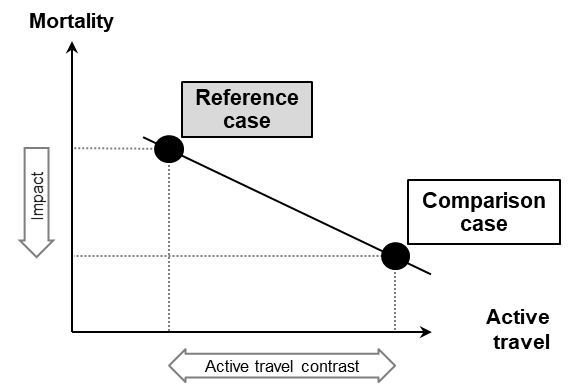
The calculation starts with the amount of walking or cycling, the size of the population and the assessment period. Population mortality rates provide a baseline for estimating premature deaths. HEAT then uses relative risks from epidemiological research to estimate how walking or cycling changes that baseline.
The relative risks are adjusted to the amount of walking or cycling entered. As the evidence concerns long-term exposure, the travel data should represent long-term behaviour. HEAT distinguishes conventional cycling, e-biking and cycling in a bike-share scheme.
Comparing assessment cases
HEAT uses comparative risk assessment: it compares a reference case with a comparison case and estimates the difference in premature deaths. A single-case assessment compares one level of walking or cycling with a situation without that activity. A two-case assessment compares two specified situations, such as current travel and a future scenario, and accounts for the time needed for travel behaviour and health effects to change.
The Comprehensive HEAT methodology page explains these comparisons, the use of relative risks and the distinction between single-case and two-case assessments, with worked examples.
Inputs and adjustment options
At a minimum, users need walking or cycling data and the size of the population assessed, together with information defining the type and setting of the assessment. See Data and assumptions for the input data, default values and assumptions.
The basic user interface provides the main adjustment options and relies largely on default values. The flexible interface offers additional choices, while the full interface provides all options relevant to the assessment. Users with suitable local data can refine their assessment through these options; see Adjusting input data for the detailed guidance.
Physical activity calculation
Learn how HEAT estimates the mortality benefits of regular walking and cycling.
Air pollution calculation
See how exposure to air pollution while walking and cycling affects estimated health impacts.
Carbon impact calculation
Explore how replacing motorized trips with walking and cycling changes carbon emissions.
Crash impact calculation
Understand how HEAT estimates mortality risks from traffic crashes while walking and cycling.
Comprehensive HEAT methodology
Explore comparative risk assessment, relative risks, worked examples, and single-case and two-case assessments.
Data and assumptions
Find guidance on input data, default and background values, and the assumptions used in HEAT.